

Demystifying YouTube Ads: A Beginner's Guide to Understanding the Costs
YouTube is one of the most powerful places for a business to find new customers, but for many newcomers, the world of digital advertising can seem confusing, especially when it comes to cost. You might be wondering, "How much do I actually have to spend to see results?" The good news is that the answer is more flexible than you think, and you are in control.
This article's core purpose is to break down the main factors that determine YouTube ad costs in a simple, clear way. We'll explore how YouTube charges for ads, the key "levers" you can pull to manage your spending, and how to set a realistic starting budget. By the end of this guide, you will have the confidence and knowledge to plan your first campaign.
The Basics: How Does YouTube Charge for Ads?
Before diving into the factors that influence cost, it's essential to understand the two main ways YouTube charges advertisers. The two main models are Cost-Per-View (CPV), where you pay only when someone watches or interacts with your ad, and Cost-Per-Thousand Impressions (CPM), where you pay for every 1,000 times your ad is shown.
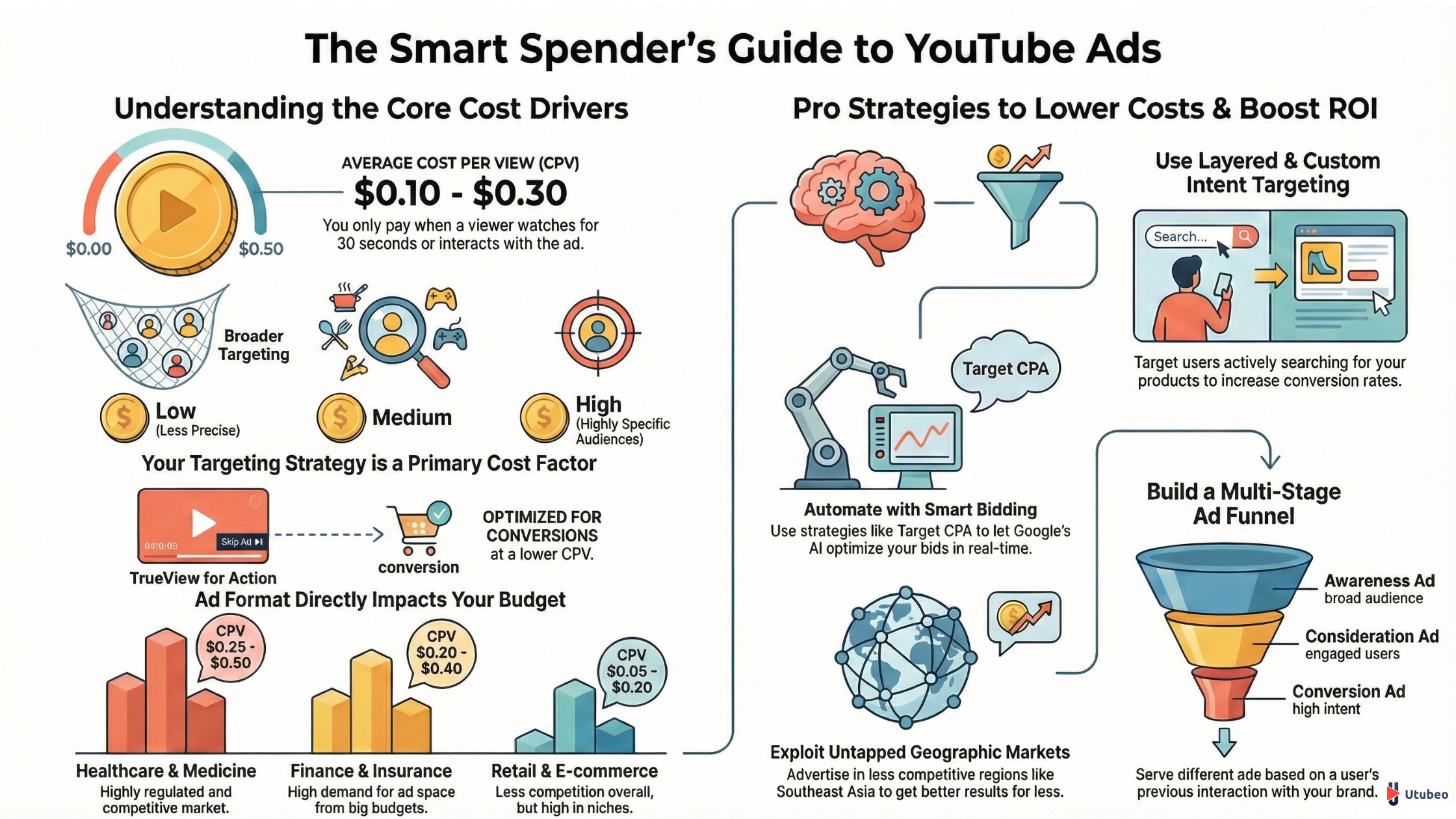
With CPV, you pay only when someone watches at least 30 seconds of your video ad (or the entire ad if it's shorter than 30 seconds) or interacts with it by clicking a link. This means you aren't paying for viewers who skip your ad immediately. As a general benchmark, the average CPV on YouTube is between $0.10 to $0.30 per view. While the average CPV provides a baseline, your actual cost is determined by a series of strategic choices. Let's look at the four key levers you can pull to actively manage that cost.
The 4 Key Levers That Control Your Ad Spend
Your YouTube ad costs aren't fixed; they are dynamic and influenced directly by your campaign setup. Think of it like having four main 'levers' you can adjust. By strategically managing your audience targeting, ad format, industry focus, and geographic reach, you can control your spending and optimize for the best possible results.
Lever 1: WHO You Target (Your Audience)
Targeting is the most critical factor in determining both the cost and success of your ads. Deciding who sees your ad is paramount. While targeting a very specific audience can sometimes cost more per view, it often leads to a much better return on your investment because you're reaching people who are more likely to be interested in your product.
Targeting Method Comparison:
- Demographic Targeting: Low - Medium cost | Why it matters: A good starting point. Targeting by age or gender is broad, which can be less expensive but also less precise.
- Interest-Based Targeting: Medium - High cost | Why it matters: You're reaching people based on their established passions and hobbies, which is a more competitive (and thus pricier) audience.
- Custom Intent Audiences: Medium - High cost | Why it matters: A powerful way to find people who are actively searching on Google for products or services like yours, signaling strong purchase intent.
- Remarketing/Retargeting: Low - Medium cost | Why it matters: This is highly cost-effective because you're targeting people who have already visited your website or watched your videos ("warm leads").
Pro Tip for Beginners: Start by exploring Custom Intent Audiences. Targeting users who are already searching for terms related to your product is one of the fastest ways to find customers and get a higher return on your investment.
Lever 2: WHAT You Show (Your Ad Format)
Different ad formats are designed to achieve different goals and come with different price tags. For example, an ad designed to make a quick impression costs less than one designed to guarantee a full message is seen.
Ad Format Comparison:
- Skippable Video Ads: Best for brand awareness | Typical cost: $0.10 - $0.30 CPV | Key benefit: Reach a wide audience without high costs, as you only pay for engaged viewers.
- Bumper Ads (6-second): Best for quick messaging & brand recall | Typical cost: $0.05 - $0.15 CPV | Key benefit: Reinforce your message at a low cost, perfect for mobile viewers with short attention spans.
- TrueView for Action Ads: Best for getting leads and sales | Typical cost: $0.10 - $0.20 CPV | Key benefit: Directly encourages viewers to click, sign up, or buy, making it ideal for conversion-focused goals.
- Non-Skippable Ads: Best for high-impact messages | Typical cost: $0.20 - $0.40 CPV | Key benefit: Guarantees your full message is seen, which is best for critical announcements or powerful brand stories.
Guarantees your full message is seen, which is best for critical announcements or powerful brand stories.
Pro Tip for Beginners: If your goal is to get sales or sign-ups, start with TrueView for Action Ads. They are specifically designed to drive conversions and are one of the most cost-effective formats for getting direct results.
Lever 3: WHERE You Compete (Your Industry)
The cost of advertising on YouTube varies significantly by industry. If you are in a field with many other businesses competing for the same audience, the ad costs will naturally be higher.
- High-Cost Industries (e.g., Healthcare, Finance & Insurance): These fields are highly competitive, and the value of a single customer is very high, which drives up ad prices. (Average CPV:
$0.20 - $0.80) - Medium-Cost Industries (e.g., Real Estate, Tech & Software): There is intense competition for specific types of buyers in these markets, leading to moderate ad prices. (Average CPV:
$0.10 - $0.30) - Lower-Cost Industries (e.g., Retail & E-commerce): While still competitive, there is often more room to target smaller, niche audiences, which can help keep costs lower. (Average CPV:
$0.02 - $0.20)
Pro Tip for Beginners: If you're in a competitive industry, don't try to outspend everyone. Instead, focus on a very specific niche audience within your market. This will reduce your competition and lower your costs.
Lever 4: WHERE You Advertise (Your Location)
Finally, where in the world you choose to show your ads has a direct impact on your costs. Advertising in more affluent countries or major metropolitan areas is typically more expensive due to higher competition and greater purchasing power.
Geographic Cost Comparison:
- United States / Canada: Higher costs
- Western Europe: Moderate costs
- Southeast Asia / South America: Lower costs
With a clear understanding of the levers that influence your costs, the next logical step is to determine how much you should allocate to pull them.
How Much Should a Beginner Budget for YouTube Ads?
There is no single "right" budget for a YouTube ad campaign, but there is a smart way to get started. The key is to begin with a small, manageable budget that allows you to learn what works without taking a huge risk.
Here is a simple framework for a starting budget:
- For Testing the Waters (Small Businesses): Start with a budget of $10 - $25 per day. This amount is enough to run your ads, gather meaningful data on what targeting and messaging resonates with your audience, and find out what works.
- For Scaling Up (Medium Businesses): A budget of $50 - $200 per day allows you to be more ambitious. With this level of spending, you can test multiple ad variations and different audiences at the same time to find winning combinations more quickly.
Pro Tip for Beginners: Treat your first budget as an investment in learning. Start small to test your ads, targeting, and messaging. Once you find a combination that delivers results, you can confidently increase your spending.
Conclusion: You're Ready to Get Started
Understanding YouTube ad costs doesn't have to be intimidating. While prices are variable, the power is in your hands. You can directly control what you spend through smart, strategic choices in your audience targeting, ad format, and initial budget.
The key to success on YouTube, especially for beginners, is to start small, test continuously, and make decisions based on your performance data. By following the principles in this guide, you have a solid foundation to launch your first campaign. You're ready to take that first step with confidence. If you need help, get solid YouTube ad campaigns set up by a top-rated experts.
![How Much Does It Cost to Run YouTube Ads for Business? [2026 Comprehensive Guide]](https://cdn.prod.website-files.com/6255d7e7e4966c523a6fb4b3/699c43eabbf2db628cfb34bc_youtube%20ad%20budget%20targeting.jpg)